Followers

30 March 2024

7th Street Shops - Rails Flanges & Gears Post 11


Friday, May 12, 2023

The Technical Files - More on Scale Coat Paint

 
Scalecoat from the 1970s

The Iron Horse introduced "Iron Horse Paint" in June, 1967 according to their ad in Model Railroader that month. It needed no primer and would not chip or scratch. The original formula was tough; an enamel that was to be baked at about 200 degrees. In fact, I've baked the paint at over 300 degrees and I regularly solder to brass models that I've already painted - out of necessity - with no real damage to the surrounding pant. The formula included both Xylene and Toluene therefore it was not meant for plastic models. However in 1967 model railroad world, plastic models needing paint were not so common.  The primary purpose of the paint was to cover model locomotives of zamac and brass and other models made of wood..   

The ad announced 15 colors (including 3 "Locomotive" colors); Locomotive Black, Oxide Red, Graphite & Oil, and Black, White, Tuscan Red, Caboose Red, Reefer Yellow, Reefer Orange, Pullman Green,  Coach Olive,  Southern Green, M & W Gray and Roof Brown. A 2oz bottle sold for a Dollar and you could get a bottle of thinner of the same size for 4 bits.

Nov. 1967

In less than 6 months the name of the paint was changed to Scalecoat and the company was rename Scalecoat Model Railroad Paint (SMRP). The first ad had invited dealer inquiries and apparently M.K. Walthers took the Que. The Nov. MR announced their exclusive distributorship of the product. From then on the paint was always distributed by Walthers.

The list of colors began to expand after Walthers took distributorship. In 1968 SMRP added 3 colors per the Oct ad; Santa Fe Blue, Union Pacific Yellow, Sliver. In April '68 they added the "Glacier Park" Green for Great Northern and included it as one of the 5 locomotive colors - along with Southern Green.

The line then looked like this; Locomotive Black, Oxide Red, Graphite & Oil, Southern Green, Great Northern Green, and Black, White, Tuscan Red, Caboose Red, Box Car Red, Reefer Yellow, Reefer Orange, Pullman Green,  Coach Olive, M & W Gray, Roof Brown, Santa Fe Blue, Union Pacific Yellow, Silver.  They offered a new 8oz size of Thinner. Up to this point only a standard 2oz bottle was available. 

October 1968


The final additions by the SMRP were the Flat and Gloss Glazes. The Nov. 1969 ad was the last version by that company. There may have been repeats of this ad in the Jan. or 


April 1969

Feb. 1970 magazine issues - there are no Scalecoat ads in those issues of Railroad Model Craftsman - but I don't have the other magazines to verify.


When Quality Craft Models (QCM) obtained SMRP sometime between Nov. 1969 and April 1970 the paint line consisted of  20 colors. This included 5 locomotive colors; Locomotive Black, Oxide Red, Graphite & Oil, Southern Green, G.N. Green and Black, White, Tuscan Red, Caboose Red, Box Car Red, Reefer Yellow, Reefer Orange, Pullman Green,  Coach Olive, M & W Gray, Roof Brown, Santa Fe Blue, Union Pacific Yellow, Silver, Santa Fe Red.


Nov. 1969

April 1970

April 1970 MR was the first advertised notice that I've been able to find where Scalecoat had been obtained by QCM. Quality Craft Models immediately issued a color chart and instruction card for using the paint.

Quality Craft Models was established in May or June 1965. Their business was finely milled basswood craftsman kits in . Their ad in June 1966 MR announced the company's first anniversary with a big sale. At that point their address was a P.O. box in Villa Vista, Pennsylvania. Quality Craft Models often advertised Scalecoat Paint as a Subdivision of QCM in their ads but when Scalecoat published an ad (about every other month) they rarely made mention of QCM. Both were owned by the Weavers from 156 Wheatley Road, Northampton, PA and they would own Scalecoat for the next 45 years.

By the end of 1970 QCM added 12 new colors plus a sanding sealer. After all, their business was primarily wooden kits. Presumably they also offered the thinner for the Sanding Sealer at that time..

This was the line up; Locomotive Black, Oxide Red, Graphite & Oil, Black, White, Tuscan Red, Caboose Red, Box Car Red, Reefer Yellow, Reefer Orange, Pullman Green,  Coach Olive,  Southern Green, M & W Gray, Roof Brown, Santa Fe Blue, Union Pacific Yellow, Sliver, 


 Great Northern Green, Santa Fe Red, Illinois Central Orange, SP Dark Gray, SP Scarlet, SP Daylight Orange, SP Daylight Red, UP Harbor Mist Gray, UP Dark Gray, PC Green, CNW Yellow, CNW Green, Baltimore & Ohio Royal Blue, Burlington Northern Green. 

It appears Toluol (Toluene) was part of the reducer formula through most of the '70s. The bottle on the right - visible in the top photo was not yet part of the product line in 1970.

Toluene was part of the formula


Undoubtedly, government regulations were part of the reason it was finally omitted but even though the paint continued to be advertised for brass and wood only the removal of Toluene helped make it more usable on plastics. Of course baking as part of the process was not comparable with plastic models. 

After 1970 ads for Scalecoat became more infrequent  Next time we will attempt to determine when the colors began to be number and  when other auxiliary product were introduced

7th Street Shops - Rails Flanges & Gears Post 10


Wednesday, May 3, 2023

The Chalk Creek Toboggan - Part 7


 "One day this week the flanger, being used by the C&S to clear the rails of ice and snow, became detached from the train, owing to a defective coupling, at the St.Elmo water tank and started off down grade. The car kept to the rails for about 2 miles and is estimated to have gained a speed of at least 75 miles (ph). On a sharp curve, it jumped the track and plunged into the bank, completely clearing the right of way and did not injure the track one bit."
- Chaffee County Republican, 5 February 1916

This would have been flanger 016 which was permanently assigned to the Buena Vista Romley run. The C&S had 4 narrow gauge flangers; 013 - 016. They were very heavy cars. By comparison the heaviest n.g. freight cars were 6 big reefers built in 1898. They weighed nearly 31,000lbs but they were also 30' long. The flangers were 17' over the end sills and weighed 18,300lbs. Considering their purpose and shortness they had to be heavy. 

C&Sng 016 O scale model of the Chalk Creek Toboggan - Pool
Snow battles were a fact of railroading in the Colorado Rockies and the railroads developed a number of "weapons" with which to do battle. The largest machines were the steam driven snow plows but there were several lesser devices as well. These included the Priest flangers that were attached to the pilot truck of the locomotives and pilot plows of various styles and sizes. The medium equipment consisted of the flanger cars.

Likely 013 Note toolbox - round targets. Como late '20s
The blades of the flanger's plow were equipped with knives that cut the ice away from the inside of each rail heads. But these were located behind the leading truck of the cars. Therefore, only the weight of the car would keep it on track when running thru solid ice; which often covered the rails.

The weight of 016 and speed it may have reached leaves little doubt that the main was "cleared" of ice and snow. That it stayed on track for two miles may be phenomenal but being such a heavy weight maybe not so much. In recollection of another version of the "Chalk Creek Toboggan" story (which I have yet to find again) the car never derailed and coasted to a stop along the relatively level stretch between Mt. Princeton and Nathrop. That does sound more like a wood-stove yarn as there were plenty of severe curves along perhaps 15 miles. The printed record is certainly believable.

08 would become 014 by September 1909 - Scott

The St. Elmo water station (an unusually small tank of just 8'x14') was almost 1600 feet down grade from the St. Elmo depot but 4 miles above the Fisher (Alpine) depot.The flanger left the track well before it could whistle past - or into - that station. 

Flangers on South Park trains were often placed behind the lead engine. This practice seems to have been problematic as several wrecks were blamed upon them. The more practical location was to put it ahead of the lead engine which must have been the case in this instance; lest it not be able to escape. Photos of 016 ahead of the engine are shown in several pictorial volumes.

 013 without plow for idler service by April '36 - Kelly

Very likely, in the 30 plus years the railroad had been using such cars, this wasn't the first time a flanger got away. This is simply the only time I am aware of that such an event was recorded. It is an interesting part of this  car's story and historical account. 


02 or 03 (1890 Snow Plow trials) round targets no tool box
The Denver South Park & Pacific built 2 flangers in 1885 and numbered them 5 & 6. They built 7 & 8 in 1887. In 1894 the Denver Leadville & Gunnison renumbered  5 & 6 as 02 & 03 and 7 & 8 as 07 & 08. In 1899 the Colorado & Southern changed 02 & 03 to 09 & 010 and assigned the vacated numbers to the Jull and Cooke snow plows (01 was already assigned to the first Rotary). The flangers were renumbered again as 013 - 016 between April 1908 and September 1909. That means 013 above was originally built in 1887 and 015 was originally built in 1885. 

The 2 builds were very similar and photographically there were only a few detail differences. All of the cars were built when the South Park was under Union Pacific control and new cars were equipped with what we call the Type B swing beam truck. Except for 015, all of the cars appeared with these trucks. But by 1936 there was a surplus of modern trucks as hundreds of type 1 coal and flat cars were being scrapped. The Leadville car, 015, appears in 1936 with a set of the ASF 4' archbar trucks from the scrapped cars. 

The two 1887 cars seem to have had round targets; indicators to the engine crew when the ice blades were engaged. An air cylinder controlled by the cab would raise the blade when passing thru switches and other possible obstructions. The 1885 cars had rectangular targets. Also, both 013 and 014 seem to have had the front end tool box at one time or another but the box has never been seen on an identifiable 1885 car. 

The last Flanger, late 1930s, Leadville - Kelly

By 1911, 014 was off the roster. Some time between 1934 and early 1936, 013 was stripped of her blades and used as an idler car for moving mixed gauge cars together. It was retired in 1936 but was reinstated in 1940 for use on the Leadville Climax run. The Leadville Mineral Belt consisted of many miles of dual gauge track. By 1938 this was the only portion of the narrow gauge left after the majority of the South Park system had been abandoned and removed in 1937. Then in 1942 the run was completely standard gauged and the two flangers were disposed of  by 1943.

015 & 016 had no box. Rectangular targets, 4-'36 - Kelly

By 1911, 014 was off the roster. Some time between 1934 and early 1936, 013 was stripped of her blades and used as an idler car for moving mixed gauge cars together. It was retired in 1936 but was reinstated in 1940 for use on the Leadville Climax run. The Leadville Mineral Belt consisted of many miles of dual gauge track. By 1938 this was the only portion of the narrow gauge left after the majority of the South Park system had been abandoned and removed in 1937. Then in 1942 the run was completely standard gauged and the two flangers were disposed of  by 1943.


29 March 2024

7th Street Shops - Rails Flanges & Gears Post 8

Monday, April 10, 2023

7th Street Shops; Pre-History Part 5

"The townsite of Romley is located at roughly 10,500' ASL near the base of the north shoulder of the ridge running more or less southward to the peak of Pomeroy Mt. El. 13,161' ASL. Just to it's east runs the small creek of Pomeroy Gulch which empties into Chalk Creek north east of the town site..."

Romley (formerly Murphy's Switch) about 1900

In the summer of 1910 the Colorado & Southern mainline still came west down Trout Creek Canyon, crossed the Arkansas River and continued up Chalk Creek to the top of Altman Pass. This was the location of the Alpine Tunnel which passed thru the Continental Divide at that point.

In those days Buena Vista was a short branch from the Wye at Schwanders located at the bottom of Trout Creek Canyon before the line crossed the River.

In late summer Trout Creek washed out

Romley depot & boarding - George R.Douthit 1956

 the line and in the fall of 1910 a small cave-in at the Tunnel cut off the entire Gunnison Division. This isolated the Chalk Creek line completely and suddenly there was a microcosm of the narrow gauge from Buena Vista to Hancock. It was a sad moment in the Railroad's history but fortuitous for a modeler with limited space and budget. I had planned one day to model most of the branch but at the moment Romley was all I had room for.

In December 1983 my first wife and I rented a home in Parker, Colorado and once again I had a place where I could build a layout. As I recall it was about 10 feet long and 18 or so inches wide. I allowed this was enough room to make a fair representation of the Romley station in 1/4" scale.

Traffic on the line was light and rarely was there more than one locomotive for 3 trains a week. It wasn't long before traffic to Hancock and Romley became the west terminal. Buena Vista had the most activity but it was a pair of very long tracks where cars were collected for exchange to and from Leadville. The Denver & Rio Grande line up the Arkansas River to Leadville was the only connection the road had to the rest of the system. Buena Vista would have been as interesting as Romley but the latter with it precipitous location seemed more interesting to model and was a better choice for the room I had.

Since the track above Romley was no longer maintained, the wye at Hancock was out of reach. A turntable was put it just above the depot in 1915. The large depot that was moved from Hancock in 1887 burned down in 1908 and a new smaller depot was built at Romley. I found a watercolor by George R. Douthit at an antique show that I instantly recognized and purchased very cheap. This was some years after the layout had been dismantled but it still contributed to my understanding of the location. The painting shows, left to right, the 2 story boarding house and the stable behind it. Across the road was the depot and the Post Office below it. The road on the left goes up to the Mary Murphy Mine. If you study the first photo you will see how the structures related the same.

The tram house just above the grade

The layout included Pomeroy Gulch and iron truss bridge. I laid my track as much as I could discern up to the depot - which was never ready for this layout. I advanced the scenery fairly well and eventually had a few representative buildings but there were a lot of compromises. My knowledge of the location was still very limited in 1983; very little detail was available in what few books I could obtain or what I could find on location. We had visited the site and camped on the town site below the grade earlier that summer. By then most of the structures were collapsed or gone.

The photo below was very helpful in building the bridge. The cars on my bridge were scratch built using Grandt Line parts and trucks. This was before San Juan Car Co. offered O scale kits of the cars in the early1990s. In fact, they used my drawings of the cars to develop the kits.

The Pomroy iron truss bridge - 1983

The Pratt Truss bridge was added to the line in 1882. A Trestle was built to cross Pomeroy Creek when the mainline was built through the location. It was kept to provide a siding at the lower end of the station and the main was shifted to the heavier new bridge. You can see this extension in the top photo. I was not aware of the trestle when I built this layout and I incorrectly double tracked I the truss bridge; there was no evidence of the trestle when we camped there in the summer of 1983.

So far as I know there was never a coaling platform - or any locomotive facilities except for the turntable - at Romley. The platform seen here was a kit of the coaling platform at Alpine Station at the Pacific end of the Tunnel. I don't remember who made the kit but I built one and plopped it down here.

As the layout grade extended a few feet beyond the bridge I optimistically planted a station sign for St. Elmo which was a few miles from Romley. Golf was a station between where the railroad serviced a huge 100 stamp mill. The mile marker and elevation on the post are correct for the location indicated.

Several scratch built box cars over the bridge

No. 62 approaches St. Elmo

My locomotive was the 1/4" scale no. 62, that I had previously converted from the no. 60 kit. I created the illusion of smoke from the stack with ink dyed cotton on a wire that was attached to the cinder catcher and wiggled during a slow shutter exposure. Today we would. Photoshop the smoke into the photo.

No. 62 approaches St. Elmo
current company. By 1918 the railroad had gotten rid of most of these cars partly because of Interstate Commerce Commission laws. Most of the cars were scratch built but the combine was a modified kit who's maker I do not remember. It represented C&S no. 22. At this point I did not have a caboose. It wasn't necessary because the combine doubled as the caboose. I built the Don Winters caboose after we moved to Colorado Springs later in 1984. However, I probably purchased the kit at the 4th National Narrow Gauge Convention in Denver of that year.
 
The one freight car that was built from a kit was the Model Masterpiece composite frame coal car in the last color photo.

The yard at Romley

I believe I scrapped this layout when we moved from Parker; though it seems part of it was in a spare bedroom in the house we rented in Colorado Springs. As I grew to understand the station more I became dissatisfied with the layout. I felt I could do better when a larger space became available, But by the time that happened I had moved on to another part of the railroad and adopted another scale. In the meantime there would be another, smaller shelf layout of this location in O scale.

I have visited Romley many times and each time a little more of it has disappeared. The last time I went thru Romley was in 2006 on our way to the 26th National Narrow Gauge Convention in Durango. We crossed over Hancock Pass (12,140' ASL), a fairly mild 4-wheel road and followed the railroad grade down to U.S. Hwy 50. Then from Montrose

My incorrect depiction at the Watercolor location

we headed south over Red Mountain Pass to Durango.

We did it all in my infamous 1998 Jeep Wrangle. That was a long day and the long way from Denver. 

Please note; corrections to this post are indicated with a different color of text.


No 62 in comparison to my stock No. 60


7th Street Shops - Rails Flanges & Gears Post 9


Monday, April 24, 2023

 Part-6


In September of 1984 I graduated with an associate degree in Civil Drafting. At the same time the 4th National Narrow Gauge Convention took place in Denver. The following month we moved back to Colorado Springs


Conoco no. 5 as of the late 1930s

Technical drawing depends upon the ability to assimilate precision of detail into a graphic message. (They are often considered legal documents.) The ability to lineally plan ahead and the skill to execute the plan are essential to a successful job. Most importantly the drawings must be authentic and correct - after all, they involve the disposition of millions of Dollars. It also pays better than the T.V. repair job that I had while in school. These skills are valuable to the craft of model building and repair work as well.

In the 1920s some C&S Reefers may have been red

The Narrow Gauge convention was the first major model railroading event I had attended. It was a wonderful and enlightening experience. Unlike the National Model Railroad Association conventions, model contests are judged by popular vote. I had entered a few local contests but never with any results. I entered a few models in the N.N.G.C. that year - with the same results. Maybe the models I entered were good, as time might prove, but because the contest wasn't "officially" judged the merits of any model were not directly meaningful. That's part of the reality of a popular vote. Years later we joked about entering Brio or Thomas "toy" trains as models to see how well they would do. After the convention I gave popular vote contests a lot of thought.

Refrigerator 597 was once a Tiffany car

The move from Parker to Colorado Springs put an end to my layout building for a very long time. There would be an occasional shelf layout and even another module for the Slim Rail group but because of the space demanded by O scale there wasn't much opportunity to build an actual layout. We moved into a home that was as big as the one in Parker but there wasn't a space suitable to work with. What I had was a small work bench upon which to build models


This plain coal car was built in 1902
The events of 1984 had a marked effect upon the direction of my hobby. With no real layout project all of my railroading efforts went into building models. My enjoyment of history was always a part of model railroading but under the circumstances I found myself indulging in the merger of model building and historical study. I realized each model could become a part of the overall historical narrative. This heightened the dedication to accuracy toward authentic representation of the prototypes. For the next decade modeling was a pursuit of this type of authenticity.

How this box appeared, when built in 1898

At that time there was no detailed narrative of the Colorado & Southern narrow gauge freight roster. There were listings of car classes and serial numbers with rough dates pertaining to the cars existence but there was no compiled history. Specific questions were difficult to answer.

It was no longer enough to just build models from general drawings and photos. These are essential but they are limited to the moment and plane on which they were created. My models had to become story tellers. In order to make that possible I had to know how and where the real equipment came from, what they "did", and what happened to them, There was an actual coal car 4319 (there still is). My model had to tell its story as accurately as I could make it.

The 550 series of reefers were the heaviest freight cars on the n.g.

Perhaps that was a distracted notion but I saw it as worthwhile. I set out to be as thorough and accurate as the available information - where ever I could find it - could afford me. I like to believe many modelers benefited from these efforts and that a better understanding of the C&S evolved because of it.

The models shared in this post represent the individual stories that each of the prototypes had to tell. In future posts of this series I will try to share some of these and other stories; as well as that of the models themselves. 

Perhaps next time we will start with that funny looking car in the photo below. 

The Chalk Creek Toboggan


26 March 2024

7th Street Shops - Rails Flanges & Gears Post 7


Tuesday, April 4, 2023


Tribute - Harry Brunk 2

The Hullkill mine head above Idaho Springs
I first encounter Harry Brunk in the pages of the "Narrow Gauge & Short Line Gazette". I discovered the "Slim Gauge News" at about the same time, but Harry's presence there was not readily apparent. Harry was the Leighton Slough of the "News" who wrote the column, "The HOn3 Scene". The SGN was published 1971 - 1974.

"The HOn3 Scene", which was an informative column meant to keep HOn3 modelers appraised of new HOn3 stuff, usually started with Leighton describing a recent adventure or encounter with another character devised out of phonetic "engineering". Leighton, a retired Yard Master (and crusty old Coloradoan) of the U.C.&N. Ry. was apparently in

Could this perhaps be Leighton's water tank?
charge of a water stop with a leaky tank. He put up with the dripping noise on a plank under the tank for 6 months before finally getting fed up enough to fix it - in the dead of winter. ("Hmmmm..." says another crusty old Coloradoan.)
Could this perhaps be Leighton's water tank?
The intrepid Leighton (Winter 1973 SGN) drained the tank, collected all of his tools and materials in a bucket and went up the ladder with the rope tied to himself and to the bucket still on the ground. He chipped away the ice and snow to open the hatch but when he turned to pull the bucket up the mere tug on the rope caused him to slip on the snow. That sent him flying off of the roof.

The famous church in Georgetown
However, the rope got tangled in the top of the ladder and stopped him high enough that he bounce off of the side of the tank. Of course, he was just out of reach of the ladder and naturally, even a sneeze would send him to the ground.

The famous church in Georgetown
And, that's where Leighton suddenly realized he was rambling and got on with business. Well! I guess you could say Leighton - Harry - was good at tales of suspense. He leaves Leighton hanging, as it were, in a rather precarious position - not just hanging off of a water tank - but in the dead of a cold Colorado winter. I don't recall that he ever explained how he got out of that fix. You might get the impression; perhaps Leighton was just yarnin' - being a bit of a yarn himself.

St. Charles type box car converted from a RGM kits


A wayside industry near Georgetown


The famous Devils Gate Bridge from the backside

I count it fortunate to have been friends with Harry Brunk. As described in the previous part of this Tribute, Daryl Leedy, Bob Axsom, Joe Crea (trip 1) or Mike Pine (trip 2) and I jumped in a car on a Saturday morning and drove the 3 or so hours from Denver to where Harry and Bobby lived in central Nebraska. Each time we stayed a few hours, soaked in the stories, the layout and the good company and then stopped on the way home in the small town for dinner.

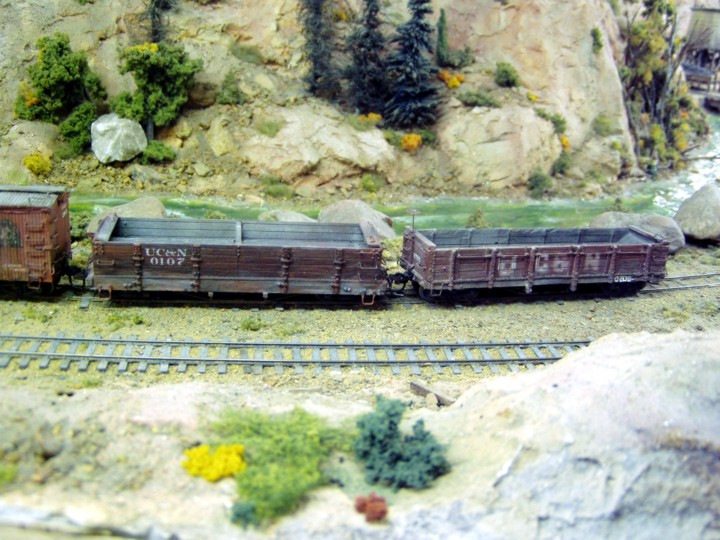
 UC&N stray box spotted at Bath, C&S - 1909 (Sn3)

On our second visit I learned that Harry and another modeler had exchanged cars from each other's roads. Since I modeled in Sn3 an exchange wasn't really an option so I asked if he would letter one of my cars. Since my modeling period was some 25 years earlier than the U.C.&N. Harry applied the older herald that was more appropriate for a car of his road to show up on my early C&S layout. I sent a car already painted and he graciously lettered and weathered it. This car is one of my treasured possessions.

During the visit we talked about the pros and cons of the scales we each modeled. He described how the HOn3 engines tended to burn up motors relatively often and he regularly had to re motor a model. Naturally, (having become utterly disgusted with HOn3 shortcomings more than once) I talked up my satisfaction with Sn3. Harry was not about to convert - of course - and it wasn't my intent to sway him but he did express his admiration for the scale. If I recall, I sent him a Cimarron Works box car kit in appreciation for lettering my car. I have no idea if he ever built it. 

0200 is a Type II rebuild.

We continued to correspond after we moved to Montana. One day he sent me pictures that were especially interesting. The 2 photos were of 3 U.C.&N. cinder cars Harry scratch built. Like all of his rolling stock they were C&S prototypes. This was especially interesting because I had researched the cars over 20 years earlier and thereafter several great models had been built. Moreover, Berlyn Locomotive Works imported a R.T.R. model in O scale. Modelers like Harry using my efforts to enrich their experience is the reward that made the effort worthwhile.


0107 is a  St. Charles rebuild
The first photo was of a 1907 (Type II) coal car (0200 in the upper photo) converted to a cinder car. On the C&S it was 1 of 15 rebuilt with side dump doors and sent to the Black Hills in 1913. The U.C.&N story was likely parallel this. Several years later they were returned to the C&S as cinder cars. But it was the other cars in the photos that were of particular interest to me. These are models of cars that the C&S rebuilt from St. Charles built cars purchased by the Union Pacific Denver & Gulf in 1898
St. Charles conversion before 1910 (On3)
The C&S took over the U.P.D.& G.cars early in 1899 and they converted 8 of them (plus an earlier coal car) into side

Another St. Charles conversion

dump cars between 1903 & 1906. But they were not for collecting cinders. They were built to haul mining tailings onto trestles throughout the system to dump and fill in the trestles. They were designated non-revenue cinder cars thereafter.
Prior to 1990 I had been researching the C&Sng freight roster to developing a series of informative drawings that were more than just representation of the railroad's narrow gauge freight cars. The subject of one of the drawings was this cinder car. I built an O scale model from the drawings with working doors and dogs and a complete underframe in 1990. That year it won the Caboose Hobbies Best of Show Award at the Rocky Mountain Division NMRA Regional Convention. The car was featured in the Aug. 1991 "Model Railroader".

Bob's Unimat lathe / mill

If you compare our models you may notice certain differences. Both versions are correct for the  intended time periods we each modeled. 7th Street Shops now offers a complete collection of the drawings on our website. This car and several others as well as additional details are included in the 25 sheet set.


After we returned to Denver, Bob, who had taken many photos over both visits assembled a viewing program for the rest of us to enjoy. Some of those photos are shared here.

In 2008 Bob hired me to paint 4 of his C&S Sn3 brass locomotives. This was before 7th Street Shops was formed. I visited his home in Denver a few times and on one occasion I noticed he had a Unimat lathe. I expressed an interest in it if he was inclined to sell it. He promised to give me first crack at it if that happened.
 
Sadly, Bob was in declining health. He quit his job at Caboose Hobbies and began selling off his model railroad collection. Robert Axsom passed away in 2014 after Vicki and I had moved to Montana. One day I received an email from his widow. She informed me that Bob had willed the Unimat to me. I was stunned. I had long ago forgotten about the machine and this was completely unexpected. In honor of Bob I attached an engraved tag and will keep the Lathe as another of my treasured possessions.
 
Tokens? Memories! Of good friends who I won't forget nor forget to share.

7th Street Shops - Rails Flanges & Gears Post 6


Saturday, March 25, 2023

Building in Brass; Pre - History Part 4


Kemtron HOn3 brass kit of the D&R G C-16

I don't know of any formal (accredited) program to earn a degree in Model Master Mechanic. It is all strictly on the job training - where one is both client and service. I thought it might be interesting to give an example of  how one might go about doing that. It's all very informal really; find a model you would like to have, build it and in the process learn more about building the next one..

Fortunately, I have a few photo examples of my early "training." Among the photos I found both 35mm and medium format negatives of the Kemtron C-16 I mentioned in part 3. I built this kit over 40 years ago after I got out of the Navy. I also found I had photos that I didn't remember taking. Somewhere along the way the Model Die Cast narrow gauge engine I sold to the modular group I was a part of happened to pass before my Mamya 645.

Model Die Cast HOn3 outside frame (C-21?)

I don't know exactly when MDC first offered the powered narrow gauge 2-8-0s - about 1974 I believe - but I purchased this outside frame kit perhaps prior to the C-16. It was an intriguing project I probably bought when I became involved with Slim Rail. I didn't have a module of my own but I wanted something to run during our shows.

Building the model was fun and straight forward and, as you can see, the C&Sng was already a strong  influence upon my efforts. I gave it my own paint scheme and fictional road name. The model was airbrushed black, silver and the masked off areas were a light sea green (Humbrol). The herald was inspired by a layout idea that I began a year or two later. I briefly described that pike in part 3 along with the white metal Keystone Shay kit. Unfortunately I didn't take any photos of either the shay or the layout. I sold the Connie to the modular group when I went to school in Denver  

I've been a photo enthusiast for nearly as long as I've been a railroad modeler. I started with a Canon SLR when I joined the Service and eventually became the ships photographer while over seas. I've taken many pictures as record and many of models that help when telling this story.

Kettle Creek is located in Black Forest, CO.

The C-16 was my first brass kit. My cheap soldering iron probably came from Radio Shack and may have been as much a hindrance as it was successful but I had learned how to solder at a pretty young age; that surely helped me get thru this project. Somewhere I purchased a tube of solder paste with flux already in it - what a novel idea! It took me a while to put it together but it turns out soldering brass takes a long time anyway. It isn't the actual soldering but the preparation and jigging that takes time. I enjoyed the "doing" and was pleased with the results. I don't recall how it ran - probably not well - but that didn't discourage me. 

 D&RG C-16 with a kit-built DSP&P Waycar

 The waycar shown with the C-16 was from a kit, probably E.& B. Valley and clearly not a very accurate example of the D.S.P.& P. prototype. I don't remember when I built it as the photos were taken some time after I sold the Canon F-1 and purchased the Mamya (1981). 

Half or more of the success of any task seems to rest on a certain confidence that you know you will figure out any issues that arise. In other words, you don't lose if you don't quit. When I finished the C-16 I built Kemtron's D.& R. G. 0-6-0t with the intent of converting it to a C & S mogul. That didn't happen. 

As I described previously I became frustrated with the smallness of narrow gauge in HO scale. I finally  traded or sold off the HO stuff to purchase (as I now recall ) an O scale Denver South Park & Pacific mogul imported by Balboa. I scratch built several D.S.P. & P. freight cars to go with it. 

I scratch built this On3 Tiffany "freezer"..
By this point I had plenty of experience building kits of all kinds. There were very few if any South Park  car kits in O scale. There were plenty of drawings and photos, however, and I found it an easy and enjoyable transition into building models that came from no kits. All of the freight cars in these photos were scratch built by collecting or making the parts and   assembling them according to the available information. 

I did find a kit for the waycar offered by Don Winters but even that could be described as scratch building out of a box. The instruction sheet provided an 

elevation drawing perhaps a brief description and

... as were all of the cars in this view

these suggestions; "get a six pack of beer, look at the drawing and published photos and put the kit together." Except for the beer (which didn't seem like a good idea for this method of construction) that is what I did. It turned out to be a fun project.


However, there came a point where I decided I still wasn't working in a direction I wanted to go. The "South Park," while fascinating in history, still didn't have the attraction its grandchild, the Colorado & Southern RY. had. I took the Mogul back to

Don Winters On3 waycar; post 1911 numbering
Caboose and traded it and several freight cars for an Iron Horse Models, On3, C&S, No. 60 2-8-0 kit. This was the most serious brass project I had gotten into up to that point. There were hundreds if not thousands of


parts in the box and the kit took many evenings to complete. If I recall, I put it together more than once because I made many mistakes.

Perhaps the greatest importance of the Iron Horse kit was how much it taught me. When I finally got it put together and painted, it looked a lot like the model below that I obtained several years later. I painted and numbered the kit as C&S 62.

I also added the detailed interior
I was fascinated with the orphaned (once D.S.P.& P. mainline to Gunnison ) branch known as the Buena Vista Romley division. I later understood more about


how no. 62 - and all of the Rhode Island connies - were unique from each other. I re-worked the model yet again.

The photo below provides a good reference of the 62 at Buena Vista in 1925. The photo was loaned to me by its creator, Richard Kindig, with 

PSC On3 No. 60 was painted when I got it

permission to make a copy negative. This was the sole motive power for that branch in the final days of that portion of the railroad


Next time I'll show you what the model of 62 looked.

C&S 62 at Buena Vista in 1925